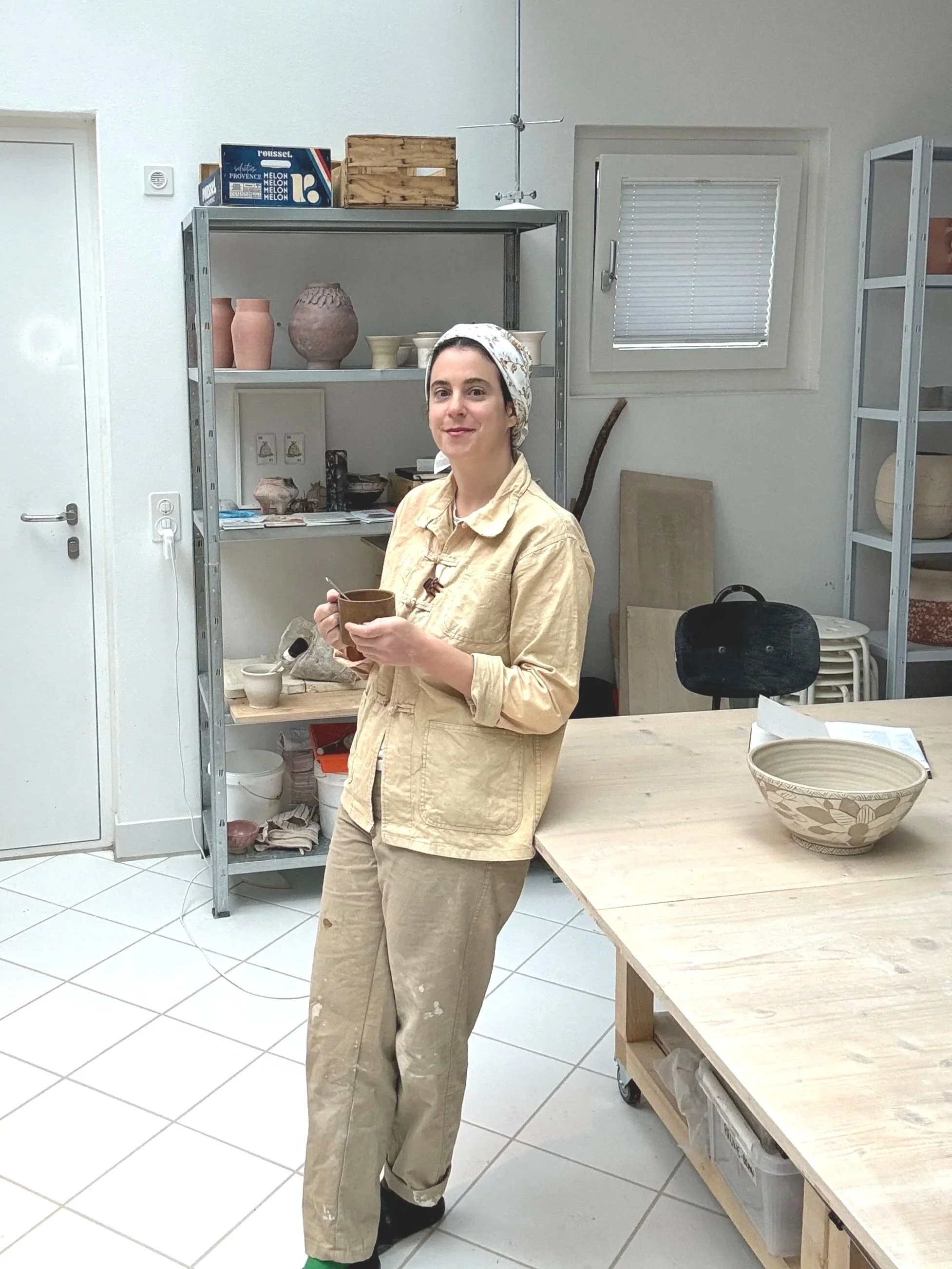
Ceramic teacher and Tao-based consultant, currently based in Zürich, relocating to Cornol, Jura suisse
At the wheel, the clay doesn't respond to force — it responds to conversation. If you force it, it collapses. A Taoist reading works the same way: not extracting a fixed answer, but reading where a situation is stuck or already wants to move, and helping someone recognise the cycle they're already inside. Both practices rest on the same discipline — staying in dialogue with what is actually there, trusting the process to slowly unfold rather than rushing it toward a conclusion. Clay & Tao was founded on this single observation, developed independently through more than a decade with clay and several years of formal study in classical Taoist analytical systems — until the two practices revealed themselves as one.
I initially trained and worked as a lawyer in Geneva before moving into the field of contemporary art. After studying art history in Paris, I founded a gallery in Switzerland dedicated to emerging artists and later completed curatorial studies at Zurich University of the Arts. This background trained a particular kind of attention — to form, to spatial perception, to the cultural context in which a practice takes shape — long before I understood it would become the same attention I now bring to a piece on the wheel or a chart in front of me.
Ceramics found me about ten years ago, and it never let go. What started as formal courses and specialised workshops became sustained studio research — wheel throwing, hand-building, glaze formulation, firing, learning humility in front of the material, respecting its rhythms, its nature, its cycles. You cannot force a good glaze any more than you can force a good decision.
Since 2022, I have studied classical Taoist systems at Ming Shan Academy in Switzerland — BaZi (often described as Chinese astrology), Qi Men Dun Jia, Yi Jing and Feng Shui. These are analytical tools, not belief systems: structured ways of reading timing, relational dynamics and decision points, in personal life as much as professional. Studying them didn't introduce a new discipline into my practice — it named one that had been present in the studio for years.
An embodied dimension of this research is cultivated through Big Dipper Qi Gong, which shapes my sense of rhythm, breath and attentiveness — at the wheel, in a reading, and in how I teach both.
Clay & Tao brings these strands together within a contemporary studio model, currently based in Zürich and relocating to Cornol, in the Jura suisse, with the studio reopening in 2027. Consultations continue without interruption throughout this transition, online worldwide and in person.
Whether you come for a pottery retreat or a Tao consultation, the method is the same: sustained attention to what is actually in front of you — the clay, the chart, the question — until it quietly reshapes how you see, act and decide.