Where This Comes From
The Arts of Tao were born thousands of years ago, out of close observation of nature. It's an empirical method — not a rational one, since it predates rationality by millennia. But it is, nonetheless, remarkably effective and practical.
The Arts of Tao: More Than One Practice
The Arts of Tao aren't a single discipline — they're a family of tools, each answering a different question.
BaZi, Chinese astrology, is a tool for self-knowledge — who you are, your strengths, your patterns. Qi Men Dunjia and the Yi Jing are strategic tools: they reveal the hidden aspects of a situation, and point to the best strategy and timing to move toward your goals. Feng Shui examines your home or workspace so that the space works for you, not against you. Ze Ri helps choose auspicious dates for a specific project — a launch, a signature, a move.
This system is remarkably versatile, and adapts to you and your question. Whether it's strategic, spiritual, relational, or business-related — it will answer you.
All of these tools — except Feng Shui, which is the subject of its own separate consultation — can be drawn on to answer your question.
BaZi: Chinese Astrology, a Tool for Self-Knowledge
A Photograph of the Moment of Birth
A BaZi chart is like a photograph of the moment of birth: a flash that captures temporality. It doesn't change — but how it interacts with each passing year does.That's what explains why some years, months, and days are more auspicious than others.
Four Pillars, Eight Characters
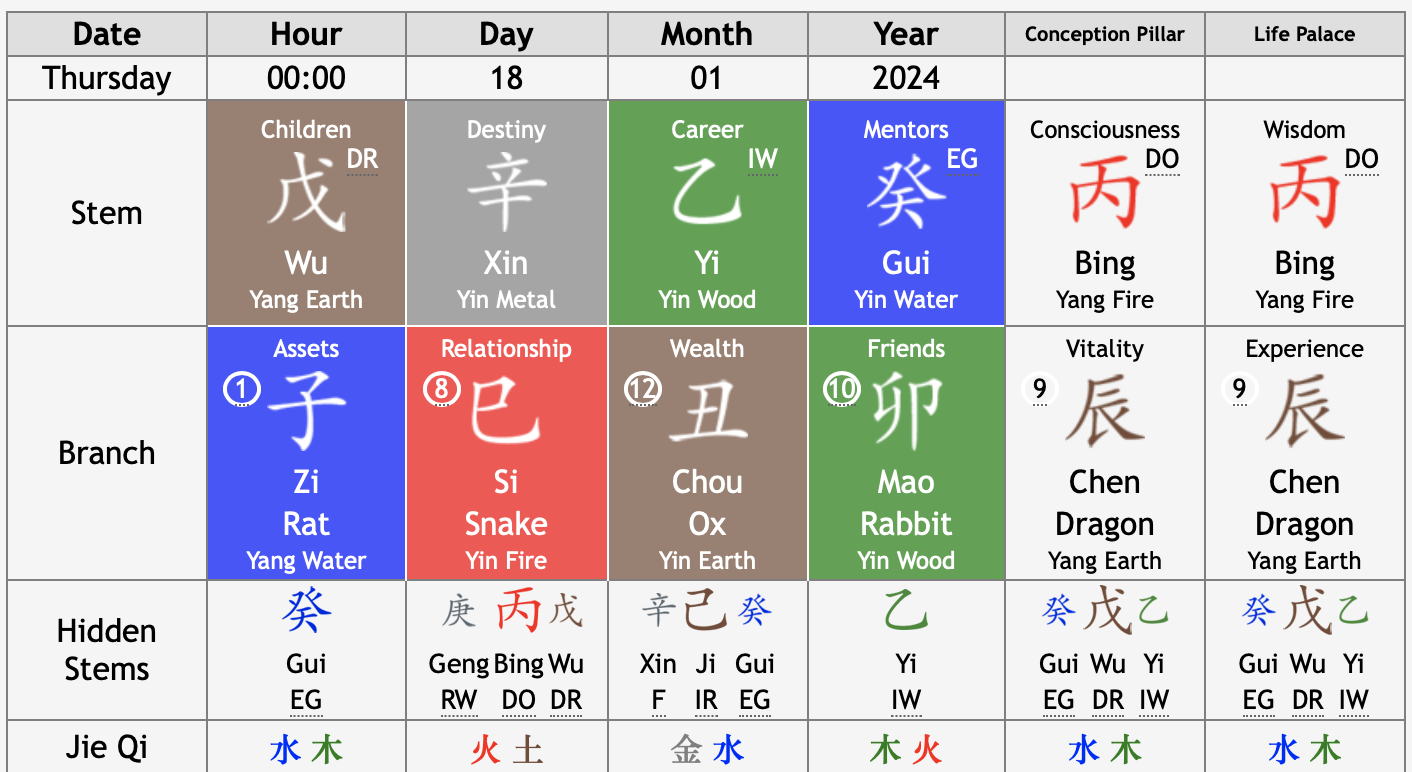
Each pillar of a BaZi chart combines a Heavenly Stem and an Earthly Branch. These are expressed through the Five Elements — Fire, Earth, Metal, Water, Wood — each in their Yin or Yang polarity.
The term BaZi means "Eight Characters" in Chinese, since the chart is composed of four pillars, each containing two characters. The reading goes from right to left:
the Year Pillar, connected to social life
the Month Pillar, related to professional life
the Day Pillar, which defines personality, self-esteem, and romantic life (the marriage palace)
the Hour Pillar, linked to intimacy and creativity
Heaven Above, Earth Below
The reading also goes from top to bottom: above, the Heavenly Stem embodies the energy received from Heaven — perfect, because it is celestial. Below, the Earthly Branch expresses how the Earth responds to Heaven — an imperfect energy, because it is incarnated, and it contains hidden stems. These hidden stems reveal their potential around one's forties, like resources awaiting emergence.
Two More Pillars: The Soul and the Yuan Shen
Beyond these eight characters, two further pillars complete the chart: the Soul (Conception Pillar), and the Yuan Shen (Life Palace)— the deepest ground of one's personality, the essence beneath the essence.
The Soul's work is to bridge the two: to connect the Yuan Shen to the earthly pillars — who we are here, on this earth, in the practical, incarnated life we actually live.
How the Elements Interact
The system uses the relationship between elements to read this chart. The interactions among the "Eight Characters" are not arbitrary: they follow the laws of the Five Elements. One element may feed another, control it, be fed by it, or be controlled by it — and these movements are expressed concretely through the chart's characters.
Concretely, this means each element in a chart doesn't sit in isolation — it's always in relationship with the others:
Feeding — one element nourishes the next in the cycle (Water feeds Wood, Wood feeds Fire, and so on). An element that's weak in a chart can be supported by strengthening the one that feeds it.
Controlling — one element restrains another (Water controls Fire, Metal controls Wood). This is what keeps an element from running unchecked — too much Fire, for instance, needs Water nearby to stay workable rather than destructive.
Producing — an element can also spend itself by producing another (Fire produces Earth, since Fire creates ash). This is useful when an element runs too strong: rather than opposing it directly, the chart can show how its excess can be channeled into production instead.
Being controlled — an element can also be restrained by another, more than it restrains in return (Wood is controlled by Metal, Fire is controlled by Water). This shows where a chart's strength meets its natural limit — not a weakness, but a boundary worth working with rather than against.

Working with an element can be literal — getting physically close to it. If Wood is missing or weak in your chart, spending regular time in a forest genuinely helps. But it can also be symbolic. As Jung reminds us, the unconscious understands symbols just as well as it understands direct experience — sometimes better. We'll find, together, small habits that gently shift your relationship to what's missing or in excess.
Reading a Chart Is Not a Verdict
Reading a chart isn't about calling it "good" or "bad" — it's about finding clarity, so you can move in the direction you actually want to go. By observing how these elemental dynamics interlace — which ones feed each other, which restrain each other, which are depleted or waiting to transform — a landscape emerges that's genuinely unique to that chart, and to that person.
Looking at a chart, you come to understand that you're made up of many different inner personalities. Recognizing this makes it easier to accept them — and to get them working together, pulling in the same direction, rather than each for itself. Because when every inner personality works for itself alone, the result is noise. And noise doesn't go anywhere.
A Dialogue, Not a Monologue
A consultation isn't a monologue — it's a dialogue. Two people can share the exact same chart and live very different lives. We talk together to see what resonates, and what doesn't.
A chart is not the territory. It remains a system — even a remarkably effective one. I won't tell you who you are — you already know that. What we'll do together is discuss how to put you on the path toward where you actually want to go.
What Happens After
After the consultation, you'll leave with clarity on your question, and a proposal for how to work with — or bring into harmony — the elements involved. This isn't magic, and it's only the beginning of the work. I can show you the door. You have to walk through it.
Taoist work isn't one dramatic action that changes everything overnight. It starts by bringing a little light into what's already there — and then, slowly and regularly, building a better inner harmony, moving closer to the goals you've set for yourself. Closer, too, to what Taoists call Yuan Shen — your original spirit, the deepest ground of who you really are.
The Three Kinds of Luck
In Taoist thought, life unfolds through three kinds of luck, or "chances," each shaping our path in a different way:
The Chance of Earth — Where you were born: your family, your country, your environment. Not easy to change, because it depends on circumstances you didn't choose. Where we begin in life sets certain conditions, and some are less flexible than others.
The Chance of Humans — Everything we do to come closer to ourselves: the actions, practices, and choices that allow us to grow. Taking a BaZi consultation belongs here. But this chance isn't infinite — at some point, we have to humbly accept what's within our reach, and honor our limits.
The Chance of Heaven — What you cannot control. Winning the lottery, meeting someone "by chance," a sudden twist of fate. You can encourage it — through practices like exploring your Qi Men guardian — but ultimately, Heaven decides.
A reading activates the Chance of Humans — but that's only the beginning. What follows is regular action, even small, in the direction you want to move. As a nod to the Chance of Heaven, I'll also share your Qi Men guardian deity with you: a kind of guide, and a way of manifesting.
Where the Work of Humans Begins
The work of Humans begins with clarifying your question. Too often, people arrive with a pretext question — sometimes without even realizing it — and only ask their real one at the end of the session. I call this the "doorknob question": the one that comes out almost on the way out the door.
Clarifying your question, and prioritizing it, matters. There's no point trying to solve everything at once. Let's address the biggest issue first, and let a few months pass before deciding, together, whether there's more to look at.
It's important to come with a question, or at least a specific area you feel stuck in — a relationship, a career, a decision, a direction. Tao gives back roughly the energy you put into it. If you show up out of curiosity alone, without having done some groundwork beforehand, you'll likely leave without much to hold onto. Giving it a focal point is what makes the work actually land.
Qi Men Dunjia & Yi Jing: Strategic Tools
Where BaZi asks who you are, Qi Men Dunjia and the Yi Jing ask when, and how, to act. They read the dynamics currently shaping a specific situation — a decision, a negotiation, a launch — to reveal what's hidden and point toward the most effective timing and approach.
Feng Shui: Aligning Your Space
Feng Shui is a separate consultation, examining how a home or workspace is organized, how energy moves through it, and what it supports or works against. It's particularly useful when moving, restructuring a space, or when an environment feels like it's working against you.
Ze Ri: Choosing the Right Date
Ze Ri is the practice of selecting auspicious dates for a specific project — grounded in the same logic of cycles and timing that runs through the other Arts of Tao.
Where to Start
Where to start is simple: observing yourself, without judging — and deciding, together, where the work actually begins.
I'm Alexandra Romy, a certified Tao consultant, trained at Ming Shan, Switzerland — the first Taoist center in Europe.
Curious to see your own landscape? A consultation is the way in.
